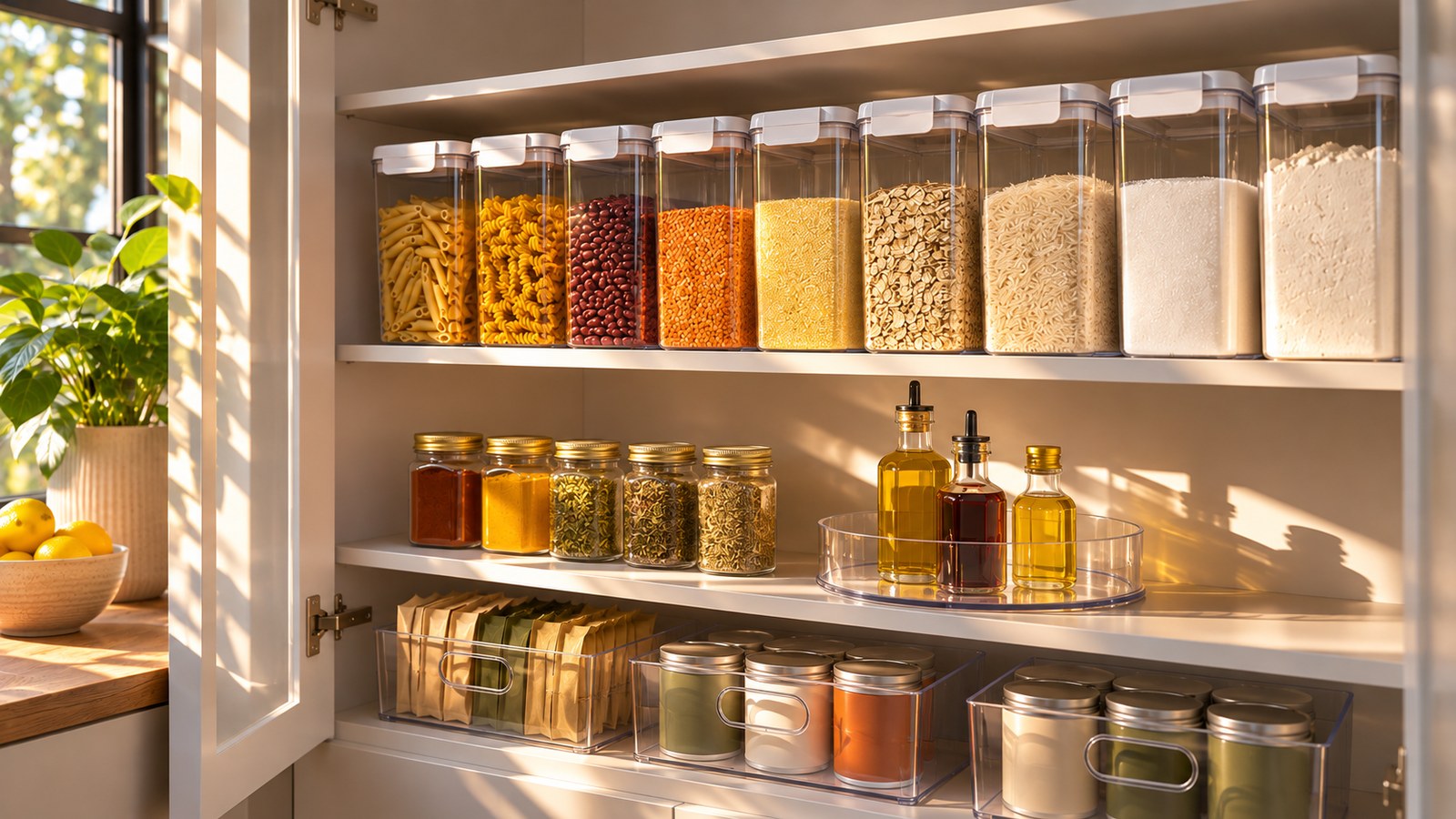
You open the pantry cupboard for baking powder and find two tins of it, both opened. Behind them hides a tin of pilchards you forgot you had, and a packet of rice has tipped over and spilt across the shelf. Sound familiar? There is room enough; the trouble is you cannot see the back. Here is how to organise a pantry in six simple steps, so every tin and packet is in plain sight and within reach.
Start Fresh: Empty the Pantry and Check the Dates
Take everything out and pop it on the counter or the kitchen table. Seeing it all at once shows you what you really have, and leaves you a bare cupboard to clean. Brush or vacuum the crumbs out of the corners, wipe the shelves with warm, soapy water, and let them dry completely.
Next, the dates, and what they really mean. The City of Cape Town explains that a best-before date generally applies to food that does not need a fridge, which covers most of a pantry. The use-by date is the critical one, and it belongs mostly to food kept in the fridge. The City also suggests trusting your senses: sight, smell and touch tell you a lot about whether food is safe.
Give the tins a once-over as well. Food safety experts advise throwing away any tin that is swollen, bulging or leaking, heavily rusted or deeply dented, or has a deep dent on any seam. A little surface rust that rubs off with a finger is nothing to worry about.
As you go, set aside opened packets and anything close to its best-before date, to use first. Duplicates, like that second tin of baking powder, get a pile of their own. Use them up before you open anything new, and leave them off the next shopping list. That pile is also a handy clue to what your household tends to buy twice.
Organise Your Pantry the Way You Cook
Organise what is left in the pantry by how you use it, not only by what it is. Breakfast things live together: cereal, oats, tea, coffee and Rooibos. Baking gets a corner of its own, with cake flour, icing sugar, baking powder and cocoa. Weeknight suppers make a third group: rice, pasta, maize meal and stock cubes, with the tins that go with them. Oils, vinegar and sauces make a fourth, and lunchbox snacks a fifth.
Now a meal or a bake starts with one group instead of a hunt along every shelf. You notice straight away when something runs low, because its group looks thin. Sunday roast in your house? Its gravy powder and spices can have a group of their own. Just keep the groups few enough for everyone at home to remember.
Organise Your Pantry Shelves by Reach
The shelf at eye level and the one just below are where your hand goes without thinking. Save them for the everyday favourites: tea, coffee, sugar and cereal.
Heavy things go low. A big bag of maize meal or a stack of tins is far easier, and safer, to slide off a low shelf than to lift down from overhead.
Children at home? Give their lunchbox snacks a low shelf or a bin of their own. They can help themselves, and anything you would rather they left alone can live higher up.
The top shelf is for the things you need a few times a year, like birthday cake decorations.
Decant What Deserves It
Decanting is worth it for dry staples whose packets will not close once opened: flour, maize meal, sugar, rice, pasta and cereal. Tins and sealed bottles are already closed, so moving them gains you nothing.
Only now do you know what needs a container, so this is the time to choose them. Measure each shelf’s depth and the height between shelves first. Our airtight food storage containers come in glass and stackable plastic, in plenty of sizes, so you can match each one to its shelf and to the amount you usually buy. Square and rectangular shapes stand neatly side by side without the gaps round ones leave, and a row of clear containers makes the cupboard a pleasure to open. For spices and smaller amounts, glass jars with tight-fitting lids work beautifully.
Two habits make decanting work. First, keep what the packet tells you. Copy the best-before date onto the container’s label, and cut out the cooking instructions and any allergen warning to tape on the back. Second, never tip new flour on top of old. Pest specialists advise against mixing old and new food, and say to clean a container before refilling it. Keep the new packet closed beside the container until the old flour is finished, then wash, dry and fill.
No More Lost Tins at the Back
A deep shelf hides its back row, and that is exactly where tins slip past their dates unseen.
Pop loose packets, like soup, gravy and yeast sachets, into a bin you can slide out by its handle. A clear one shows you what is inside at a glance. Bottles of oil, vinegar and sauce sit happily on a turntable, or Lazy Susan, in a corner or at the back, where one turn brings the back to the front. A clever trick for tins: a tiered rack lifts each row above the one in front so every label shows.
Our clear storage includes nifty bins with handles from 4.5 to 11.5 litres, and a four-compartment organiser for smaller sachets. You will find turntables among our pantry ideas. Measure the cupboard’s door opening too, so each piece fits through it.
Label It, Rotate It, Check Before You Shop
Label every container with what is in it. Cake flour, bread flour and self-raising flour look remarkably alike out of their packets! Mark each bin with its group too, so whoever unpacks the shopping knows exactly where things go.
When you unpack, slide older tins and packets to the front and put the new ones behind. Then, before you write a shopping list, open the cupboard. With the food in groups and the bins clear, a quick look tells you what to buy.
Quick Pantry Tips
- Keep a sheet of paper on the inside of the cupboard door. Whoever finishes something writes it down, so nothing is bought twice.
- Snap a photo of the open pantry before you leave for the shops, so you can check it in the aisle.
- If one item keeps finding no home, give it a bin of its own.
Keep Your Pantry Cool, Dry and Pest-Free
Pantry food keeps best somewhere cool and dry, ideally below about 29 °C, food safety experts advise, and never above or beside the stove, under the sink or in a damp garage. In summer, give your food the coolest, driest cupboard you have.
Pantry beetles, weevils among them, and pantry moths usually arrive already inside a packet from the shop, pest specialists note. A container with a tight-fitting lid stops one bad packet spreading to the rest; plastic bags will not do. If a packet ever shows tiny holes, fine webbing or small beetles, throw it away and check the other packets, opened ones first. Then vacuum the corners and wash the shelves with soap and water. The specialists do not recommend insecticides for pantry pests.
Ants come for the sweet things, so keep sugar, syrup and honey in closed containers, wipe up crumbs and spills, and clear an ant trail with soapy water straight away. It removes the scent the ants follow.
Keep It Up: Organise Your Pantry Little and Often
Once you organise your pantry this way, a few minutes a week keeps it that way. Put back anything that has wandered and wipe up the crumbs. Every few weeks, go through it shelf by shelf, check the dates and use up the tins you have had longest.
Next time you reach for the baking powder, there will be one tin, right at the front, with its date where you can read it.